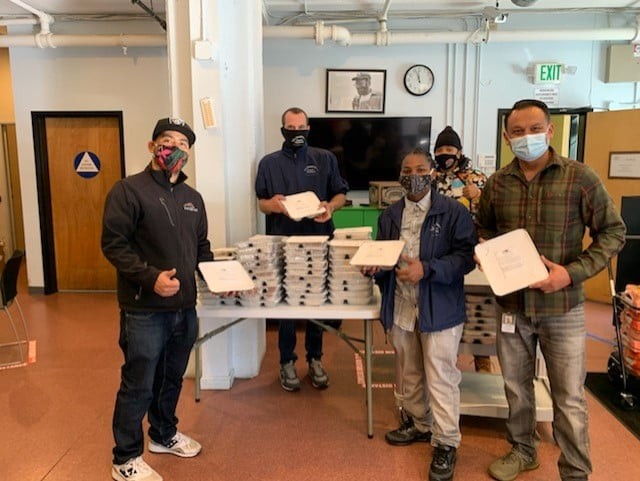
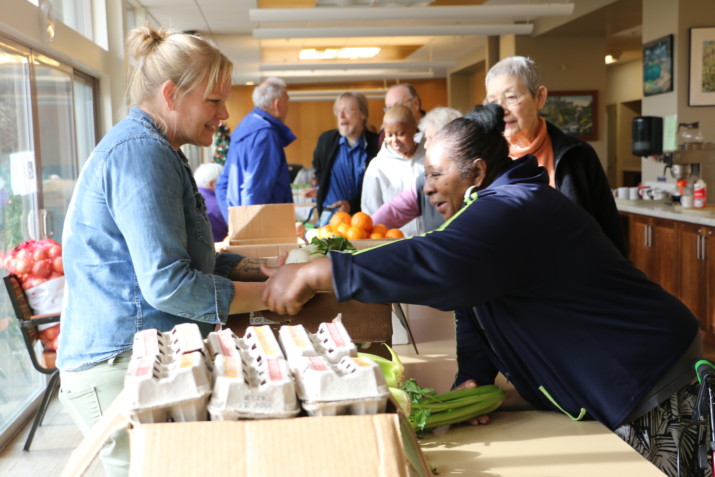
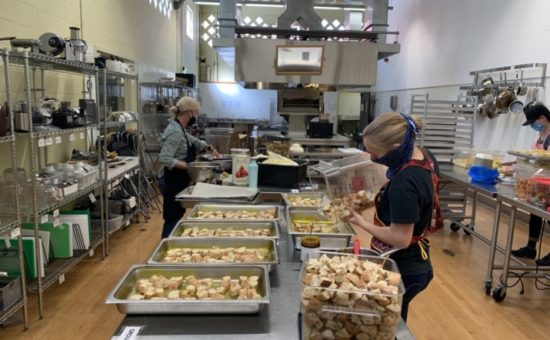
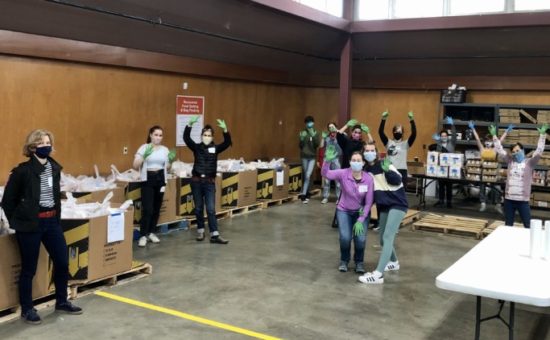
San Francisco, CA. During COVID-19 restrictions the nonprofit serving veterans, Swords to Plowshares, had to adjust several group-oriented services, especially permanent housing. Development and Communications Director Colleen Corliss stated that Swords to Plowshares faced a “huge challenge” in making sure veterans received the benefits they needed while adjusting to CDC guidelines. “We immediately had to cancel all of the congregate meals that we serve in our housing sites,” Corliss said, “and yet we still had to feed people which creates a lot more work and money to prepackage every meal for every person, for 500 vets.” This November, Swords to Plowshares and Prubechu served over 200 Thanksgiving meals to homeless veterans throughout the SF area (seen above).
Swords to Plowshares was first established in 1974 by a group of six veterans who were growing concerned that the Veterans Administration (VA) was not appropriately addressing the issues returning soldiers faced like Post-Traumatic Stress Disorder (PTSD) and other debilitating conditions.
There is evidence that the VA had turned away a Vietnam veteran with undiagnosed PTSD for decades when he attempted to reach out for help. Corliss added that veterans were often denied their full benefits only because they had a less-than-honorable discharge from their military service.
The lackluster economy of the 70s, minimal benefits handed by the VA, and the divisive cultural shift Americans had for Vietnam vets caused them to struggle even more in adjusting to a new life after the war.
Veterans needed support and validation that “the military service caused some trauma, and the Department of Defense caused some suffering,” Corliss said.
Swords to Plowshares started as a safe community for veterans before being officially recognized by the VA in 1976 as a nonprofit organization formally representing the benefit claims of veterans.
Swords to Plowshares then started to provide a range of services in the coming decades to veterans that include legal support, financial advice, and housing assistance.
“Primarily, our [permanent housing] residents are seniors,” Corliss said, “all of them are formally homeless and all of them have one or more disabilities.”
As the 2020s began, the nonprofit would have to start making major adjustments to its services when the pandemic began to endanger the lives of millions of Americans.
Veterans and their families who are in the middle of transitioning to permanent housing are typically placed temporarily in hotels for a few days to a couple of weeks. However, due to the pandemic, they have been forced to stay in their hotel rooms for several months due to the slowed process of getting permanent housing.
Mental health services were another challenge as Swords to Plowshares had to cancel all group-oriented meetings which is a major part of supporting veterans with mental health issues.
Currently, Swords to Plowshares has figured out how to continue supporting veterans with “a ton of new food partners, building up our emergency housing program out of nothing, and making those folks in hotels are getting on-site case management.”
Despite Swords to Plowshares’s successes in making the necessary changes to function in the pandemic, mental health for veterans continues to be an issue due to the current limitations on group meetings.
“It’s been sort of a creativity game of what can we do to make sure that people aren’t isolated and actually engaged in the community without actually violating any of the public health placed orders,” Corliss said.
One of the major goals of Swords to Plowshares in the coming years is to find an “in-between” with normal senior living facilities and their permanent supportive housing units for veterans. Several veterans are unfit for traditional senior living facilities due to substance abuse issues, mental health needs, and other problems that require special assistance.
“In the city, there’s no such thing as a boarding care facility anymore because of greed, they’re no longer profitable,” Corliss stated, “that’s our biggest priority right now because three-quarters of our residents are seniors.”
If you would like to help Swords to Plowshares to continue providing veterans with all of its immense services, click here to donate.
From Swords to Plowshares:
We are a community-based not-for-profit 501(c)(3) organization. We are dedicated to supporting nearly 3,000 homeless, low-income and at-risk veterans in the Bay Area every year. We offer employment and job training, supportive housing programs, permanent housing placement, counseling and case management, and legal services.
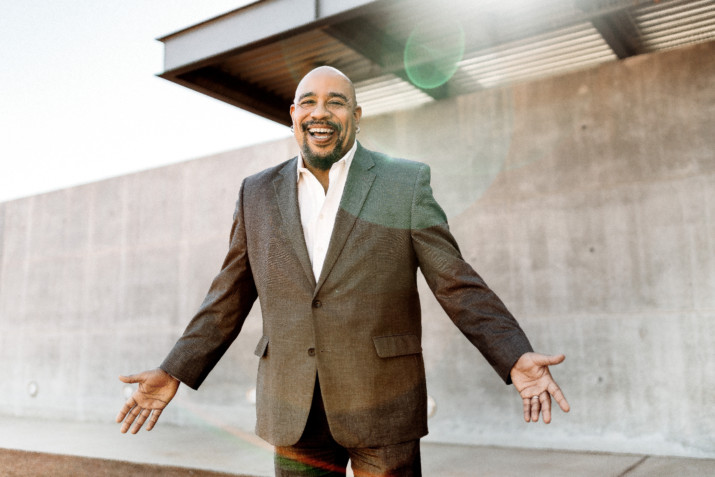
San Francisco, CA. The San Francisco Arts Commission announced that Ralph Remington has been appointed as the new Director of Cultural Affairs. (Photo credit, Photo by Aminda Villa) Remington will bring decades of leadership experience in the arts and a focus on equity, diversity, and inclusion to the San Francisco Arts Commission. He was hired by the City following a comprehensive search led by the Arts Commission with the announcement on November 6th. He will begin in January 2021.
The Director of Cultural Affairs leads the administration of the San Francisco Arts Commission and directs citywide cultural activities in all aspects of the arts through programs, special projects, grant making, and policy-setting initiatives. The Director reports to the 15-member, mayoral-appointed Arts Commission, which is responsible for the Civic Art Collection, Civic Design Review, Cultural Equity Grants and other funding, SFAC Galleries, public art, art vendors, and seven cultural centers.
The nonprofit San Francisco Arts Commission is working hard to help nonprofits stay afloat. Mission: The San Francisco Arts Commission is the City agency that champions the arts as essential to daily life by investing in a vibrant arts community, enlivening the urban environment and shaping innovative cultural policy.
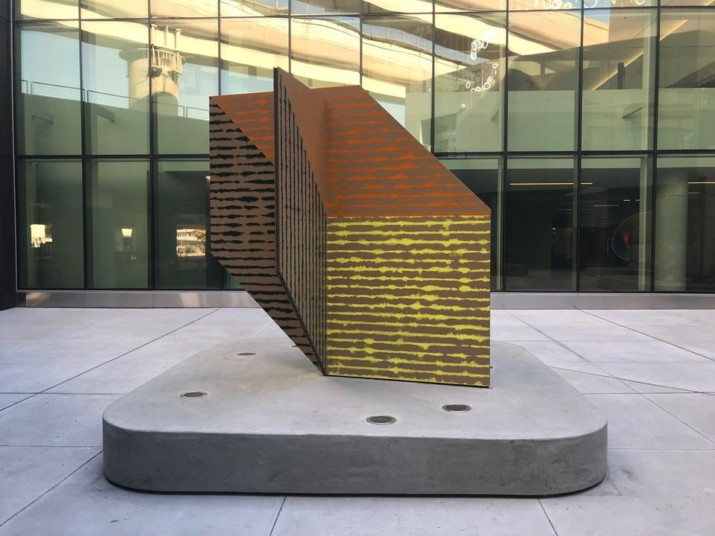
While we encouraging everyone to #stayathome this holiday season, the commission also wanted to share some of the artwork that has been recently installed at San Francisco International Airport (SFO).
San Francisco-based artist Gay Outlaw’s bold, geometric sculptures, located in the South Courtyard at Terminal 1, take inspiration from both architecture and nature and incorporates color and texture in playful and surprising ways.
The San Francisco Arts Commission is committed to creating a city where all artists and cultural workers have the freedom, resources and platform to share their stories, art and culture and where race does not predetermine one’s success in life. We also acknowledge that we occupy traditional and unceded Ohlone land. Fueled by these beliefs, we commit to addressing the systemic inequities within our agency, the City and County of San Francisco and the broader arts and culture sector. This work requires that we focus on race as we confront inequities of the past, reveal inequities of the present and develop effective strategies to move all of us towards an equitable future.
San Francisco, CA. Minds Matter San Francisco (MMSF) is an education nonprofit that transforms the lives of low-income high school students with demonstrated motivation by broadening their dreams and preparing them for college success. (A recent enrichment included the skydiving expedition, pictured above.)
The organization raised $347,877 on October 7th, during its virtual fundraiser.
Founded in 2010, 100% of alumni have been accepted to 4-year colleges, and 97% are on track to graduate from college within 4 years. Students – compared with similar peers – are 25X as likely to graduate from a selective college that prepares them for career and beyond.
Minds Matter San Francisco (MMSF) was also recently named “2020 Top-Rated Nonprofit” by GreatNonprofits, the leading website of user reviews of charities and nonprofits. The organization noted the achievement in October.
Target demographics: Low-income high school students who are the first in their families to go to college.
Direct beneficiaries per year: 224 mentees (current and alumni)
Geographic areas served: San Francisco
Programs: Our students participate in a rich set of programs including young professional mentorship, academic planning programs, MMSF-supported summer college programs for high school students and SAT & ACT instruction.
Minds Matter San Francisco aims to help high school students with demonstrated motivation from low-income families achieve their dreams of attending college.
San Francisco, CA. HandsOn Bay Area is offering Virtual Volunteering programs. The program is a volunteer-driven response to the COVID-19 public health emergency. While volunteers may need to be physically apart right now, they can still engage in meaningful virtual engagements that support our community. These shared experiences bring volunteers out of their isolation and mobilize them to a greater good.
There are often opportunities to volunteer as a family.
The organization is offering five reasons to participate:
Team-based virtual experiences that benefit the community and help teams connect
Easy and high impact done in a day projects for volunteers
Curated experiences that align with your team’s interests and meet a community need
All project scoping, planning, and execution will be handled by our team of professional non-profit volunteer managers to ensure a high-quality volunteer experience
Connect with your community and make a real difference
Another program is “Digital Dialogues”. It is a facilitated discussion between volunteers, community leaders, and HandsOn Bay Area staff that centers the issue areas affecting our communities. Possible topics include:
Disability Justice
Hunger & Homelessness
Race Relations & Police Brutality
These virtual convening spaces are dedicated to sharing, learning, and critically reflecting on the social issues that matter to each and every one of us. Organizers encourage you to bring your passion for a better world and a commitment to your community.
From HandsOn Bay Area:
We connect companies and people with high-quality volunteer projects through our extensive network of local nonprofits and schools in need.
We help companies — including Google, Salesforce, Levi’s and many others — create customized volunteer events to make their employees happier and better serve society.
And we offer hundreds of volunteer projects each month to anyone who wants to help, covering all the causes people care about.
In 2017, we mobilized over 25,000 volunteers, resulting in more than 76,000 hours of service to more than 280 schools, parks and nonprofits across the Bay Area. Our volunteering projects meet critical community needs including education and literacy, youth development, health and aging, homelessness, the environment and more.
San Francisco, CA. Based on the historical Haight Street of San Francisco with another volunteer center in Berkeley, Prisoners Literature Project has delivered packages of literary material to prisoners for over 30 years. Unfortunately, the outbreak of COVID-19 has hindered both the organization to provide books to inmates as well as the prisoner’s ability to participate. While still sending out hundreds of packages per month, that amount is nowhere near the previous volume Prisoners Literature Project (PLP) was able to distribute.
PLP relies solely on volunteers to package and mail specific books, however social distancing guidelines in response to the pandemic have prohibited the organization to continue their normal volunteer operations. Simon Carless, a volunteer and social media advocate for PLP, emphasizes the organization’s total reliance on volunteers and donations; “Nobody is being paid by the organization, so for us, it’s important that all the money we receive goes directly to helping prisoners.”
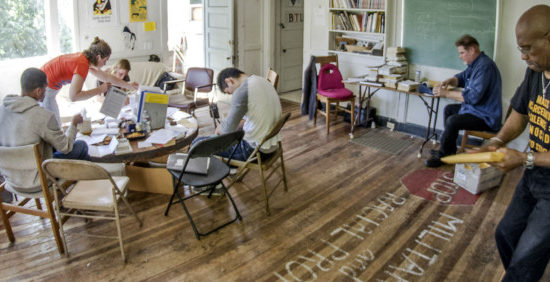
Volunteers such as those pictured are no longer able to gather and pack or distribute literature in The Grassroots House due to COVID. PLP hopes to return to their normal volunteer-based practice soon.
Partnerships with other nonprofit organizations further allow PLP to provide prisoners with a diverse collection of literature. Grassroots House is the parent organization to PLP, and Carless describes the nonprofit as a “collectively run physical space”. Grassroots activism allows increased diversity among both literature donations and volunteer demographics; “We do have a whole bunch of backgrounds, jobs, and ages, yes. I think everyone has a different view on why they are doing this and how they can help – so as a collective we try to self-organize so that everyone is doing what they want to do to make things better.”
PLP is also partnered with the Prisoner Activist Resource Center and includes the organization’s brochures within their literature packages to provide prisoners with information regarding resources and fundamental business knowledge. In addition to the education and resources prisoners receive through the PLP, Carless is proud of the more spiritual and therapeutic ameliorates their organization provides as well. “Many prisoners request dictionaries and thesauruses, so for them, their literacy is important….But in general, when they are in such isolation or have such poor access to reading materials, a great result is an improved state of mind and the feeling that somebody is looking out for them. We hope!”
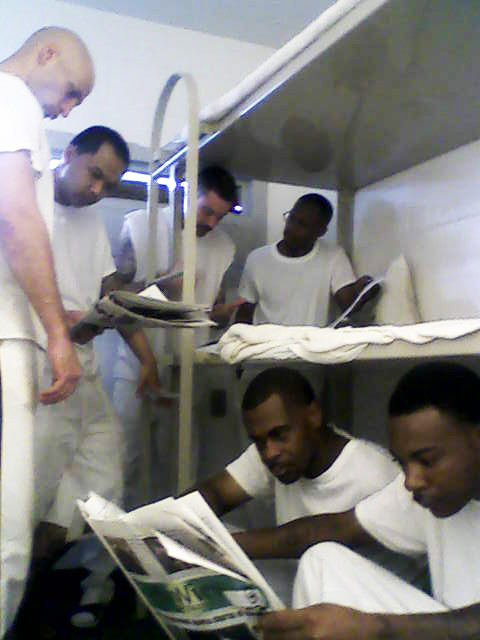
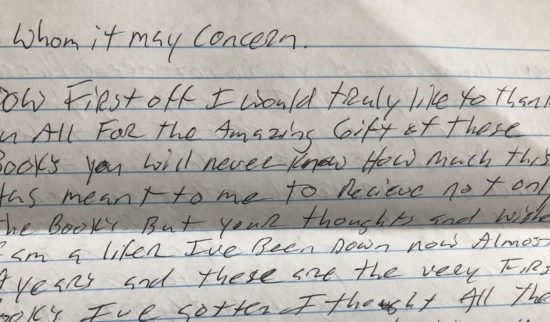
Carless highlights the organization’s appreciation for the letters of thanks PLP receives from prisoners due to their work.
While COVID has hindered their operation, Prisoners Literature Project continues to accept donations and hopes that both their dedicated volunteers as well as the prisoners who have had their resources restricted due to the pandemic can once again engage in the efforts of the organization. Carless acknowledges the immense impact of COVID on PLP; “Many prisons are in lockdown or partial lockdown and have been very badly affected by COVID, which is very sad. And PLP itself has had to stop doing group volunteer sessions, which has majorly affected our ability to send out packages. (We are still sending out hundreds per month, just not as many as we did.) We hope to get back to normal soon, but it’s difficult for everyone concerned.”
https://www.prisonlit.org/
From Prisoners Literature Project
The Prisoners Literature Project is an all-volunteer, non-profit group that sends free books directly to prisoners who request them from throughout the United States.Working almost continuously for thirty years, our U.S. prison books program has gotten (literally) tons of books into the American prison system, while staying overwhelmingly ‘grassroots’ – no full-time employees, no overhead eating up your donations.
Partnerships
Prisoner Activist Resource Center – https://www.prisonactivist.org/
The Grassroots House – https://grassrootshouse.org/
Berkeley, CA. Berkeley Food Network, a middleman between large food sources – such as food banks or markets –and community distributors, has more than tripled its community impact in just two months. According to the nonprofit’s Executive Director Sara Webber, “With COVID we went in two months… from serving 1,600 people a week to 5,000 people a week.”
When it was founded in 2016 by Sara Webber, Dona Boatright, Chuck Fanning, and Kate Campbell King, the Berkeley Food Network worked it’s way up to serving around 300 food-insecure people. In two years, thanks to partnerships with community organizations like Head Start, senior and medical centers, as well as the Alameda County Food Bank, that number grew to 1,600. But the Coronavirus outbreak and California’s shelter-in-place order “completely changed our operations,” Webber notes. “We’re saying it’s our silver lining.” And indeed, the pandemic has given people who may be reluctant to ask for free food the push they need to accept help.
Berkeley Food Network employees pose for a photo pre-COVID-19.
An essential part of the Berkeley Food Network’s model is destigmatizing food handouts. At the nonprofit’s farmer market-style pantries, staff shop alongside food insecure people, taking just a few items. The goal of this is to normalize free food, and the strategy works; customers feel more comfortable and participate more. Since the shelter-in-place order, the Food Network has shifted from running pop-up pantries at convenient times and locations for families to delivering pre-packed grocery bags to community partners. One such partner is Headstart, a preschool for low-income children that is run by the YMCA. Once a month the Berkeley Food Network sets up a food pantry at Headstart from three to five in the afternoon, so parents can easily access free food while they are picking their kids up. Although Headstart was forced to suspend its program due to COVID, BFN has found numerous new community partners.
A mother and daughter pick food from a BFN pop-up pantry prior to the onset of the pandemic.
Despite the many organizations devoted to feeding the hungry in and around Berkeley, “There are a lot of people falling through the holes,” according to Webber. That is where BFN comes in. They work with partner organizations in the community to get food where it is most needed. Research by the Food Network shows that 24,000 Berkeley residents were food insecure pre-COVID-19. However, only 6,000 of them had access to regular food assistance. It is the Berkeley Food Network’s mission to close that gap by developing strong and collaborative community partnerships to reach each of those 24,000 people with healthy food.
Masked BFN workers sort food to be distributed to families.
Healthy food is a hallmark of Berkeley Food Network. They never distribute sugary drinks or foods – most of their produce is sourced from hyper-organic community gardens like King Middle School’s Edible Schoolyard and Urban Adamah. In addition, BFN receives donations from personal organic gardens. To fill in the cracks, BFN’s food recovery program sources food from local businesses that would normally throw away imperfect, but perfectly healthy, produce. Packages typically contain food for an entire family to eat three meals.
BFN warehouse workers pose for a masked photo.
If you are interested in getting involved with Berkeley Food Network:
From Berkeley Food Network: Did you know that 1 in 5 Berkeley residents are not able to put enough food on their tables to live healthy, hunger-free lives? The Berkeley Food Network was founded in December 2016 with the goal of ending hunger in Berkeley. We have an innovative mix of community-centered and collaborative programs to get healthy, nutritious food to the people in Berkeley who need it. At the heart of this work is our food sourcing and distribution hub operating out of our warehouse. We source food from the Alameda County Community Food Bank and local food businesses that is later distributed to Berkeley residents. The graphic below outlines specifically how our community-centered approach operates to end hunger in Berkeley.
NONPROFIT BENEFIT TICKET GIVEAWAYS!
Sign up for our free weekly highlights for the chance to win two tickets terrific nonprofit events! If you “like” us on facebook, or sign up for our weekly news highlights, you’ll be entered to win! Sign up today!
Look for another ticket giveaway soon! Are you a nonprofit looking to bolster your publicity with facebook and tweets? Email us and we’ll run a contest with tickets to your event! [email protected]
Categories
Archives
Affiliates
Deprecated: Using null as an array offset is deprecated, use an empty string instead in /home2/societz9/public_html/sfsocietypage/wp-content/themes/Divi/includes/builder/class-et-builder-global-feature-base.php on line 188