San Francisco, CA. The Eviction Defense Collaborative (EDC) continues to fight against the impact that COVID-19 has on those who pay rent. The nonprofit’s office is currently closed to clients but is still available online and by phone. Those who have received a Summons & Complaint or have been served a notice may contact the assistance line at (415) 659-9184 or email EDC here.
The pandemic has caused many Americans to have financial issues, but for those who can no longer rely on a steady paycheck to pay their rent can be in immense danger. Problems associated with evictions in San Francisco have increased, and if people are forced out of their homes, this can aggravate the already deadly health crisis.
According to the EDC Right to Counsel Coordinator at the time of the interview, Michael Chen, many in the community are being asked to choose between buying groceries or paying rent, and have had their financial situation worsened by the pandemic. Chen elaborates on the purpose of the organization.
“We provide free legal services for people facing eviction in San Francisco (just ranked one of the most gentrifying cities in the US!),” Chen said. “Almost all landlords have attorneys when they begin eviction proceedings but almost no tenants have their own attorneys, and many cannot afford them. Our services fill the gap between this obvious power imbalance and essentially help provide a voice for tenants who are getting evicted. The easiest way to think of this is like public defenders, but for evictions.”
Chen said that some of the services have seen increased demand.
“Because of San Francisco’s relatively strong tenant protections during COVID, our legal clinic which helps tenants file answers and find attorneys has been less busy,” Chen said. “However, our rental assistance department has been extremely busy as many, many more tenants face income insecurity and are being harassed by their landlords to pay rent, despite the Mayor’s Moratorium.”
Most of those who utilize the EDC’s services are low-income and work in the service or gig industry, which can mean that their finances are not consistent.
According to Chen, to help the EDC you can: “Call legislators and advocate for stronger tenant protections – not just delaying payment but significantly reducing payment burden. We also accept donations through our website and funds go directly towards saving housing of the most vulnerable populations in San Francisco, preventing either homelessness or mass exodus of low-income folks from San Francisco.”
If you believe the office may be able to help with financial assistance (RADCo) for the payment of rent, please call (415) 470-5211 or email us here
The EDC provides legal assistance to people who are in legal proceedings for eviction in San Francisco. Learn more here.
If you are behind on rent, you may be able to avoid having an eviction filed against you. Learn more here.
The Shelter Client Advocates work with residents of homeless shelters funded by the City and County of San Francisco to monitor shelter conditions and the application of shelter rules. Learn more here.
EDC is the Lead Agency to design and implement San Francisco Right to Counsel. Universal right to counsel in eviction is a proven and cost-effective way of keeping people housed. Learn more here.
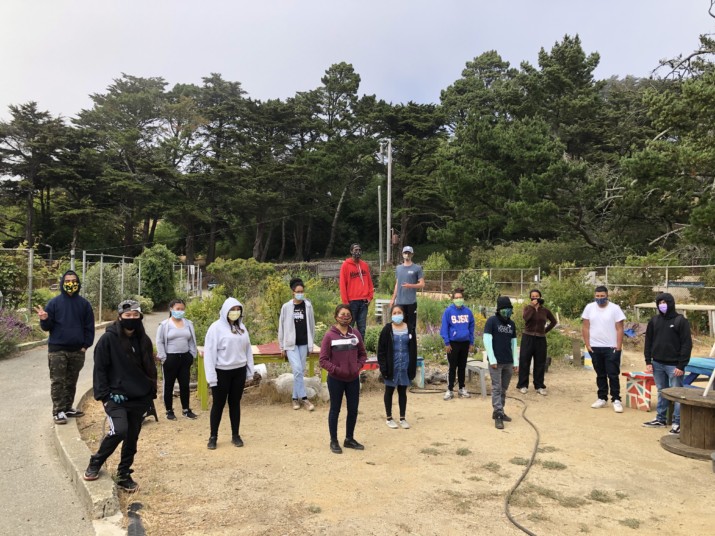
San Francisco, CA. Even though Urban Sprouts heavily relies on in-person gatherings, this non-profit is still finding ways to serve the community during the COVID-19 pandemic. The nonprofit operates five community gardens in the San Francisco area with a focus on garden-based education, job readiness, cooking, and nutrition.
In response to how Urban Sprouts is fairing during the pandemic, Director of Operations, Marissa Alexander, states “We have had to make major modifications, but we find ourselves to be a vital resource and space.”
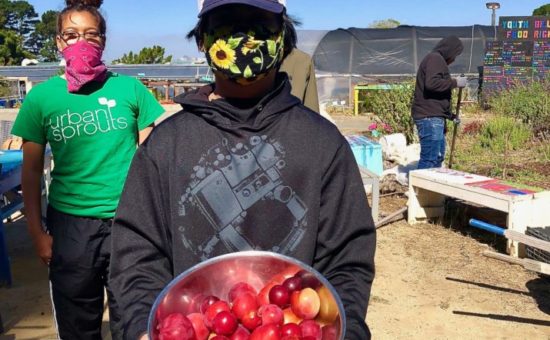
Urban Sprouts is planning to grow more food this season, with a goal of 400 pounds of produce. Marissa explains the reason behind this influx in produce: “When Shelter in Place started in March, we immediately recognized the need to get fresh produce into the hands of our communities who may have lost jobs or income, have more people home to cook for, or who may be unable or unsafe to go to a grocery store.”
Sprouting Leaders member displays harvested produce.
As food producers, Urban Sprouts was able to continue working and growing in their gardens. This was done with strict health and safety protocols in place which abided with the City orders and health directives. While complying with these protocols, Marissa notes that “Thanks to our proactive staff, early on, we were able to connect with other community organizations and gardens to partner on food distribution to those in need in SF.”
Urban Sprouts has also been able to modify and continue certain programs. Marissa references how “In March, we were running Sprout Out! which is our sort of flagship after-school job-training program for San Francisco high-school students, which is very hands-on. When Shelter in Place started, we followed the lead of SFUSD and started distance learning and the participants were all able to complete the program.”
Here’s a video about the program:
The Cooking & Nutrition program was also altered due to shelter in place, allowing for positive developments. “The shelter in place has really pushed us to develop more virtual tools that can hopefully improve our work even after shelter in place is lifted. Our cooking & nutrition program manager, Violeta Sandoval started to make amazing cooking videos to share with our online community because she missed her cooking classes! Her son, Alejandro even joined in to make kid-friendly, Spanish language recipe videos.”
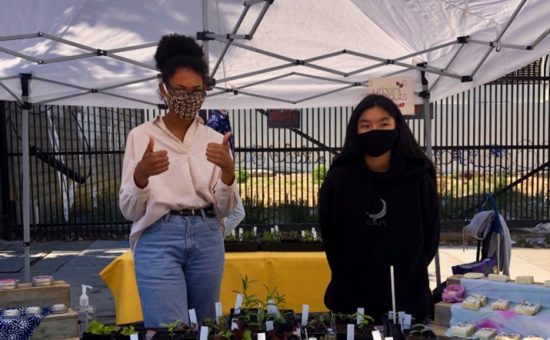
Sprouting Leaders program members attend a Farmer’s Market to sell produce.
Urban Sprouts Sprouting Leaders program was also able to continue in a modified, socially distanced manner with permission from the City and funders. This allowed the organization to bring on 12 young adult cohorts in a six-week paid summer internship program.
Marissa and the rest of the team at Urban Sprouts are also investing in the infrastructure of their sites. They are planning to make additions such as more hand washing stations, solar-powered hot water, additional shade structures, wind barriers, and solar lighting. Marissa believes this is preparing Urban Sprouts “to be even more of an outdoor asset, especially as schools explore outdoor learning.”
Currently, due to shelter in place, Urban Sprouts is unable to host events, fundraisers, and classes which would typically help them earn income. Marissa comments that “Now more than ever, individual donors are so, so important to non-profits like us. These donations help us keep going and make sure we are able to respond to the ever-changing circumstances under which we operate.”
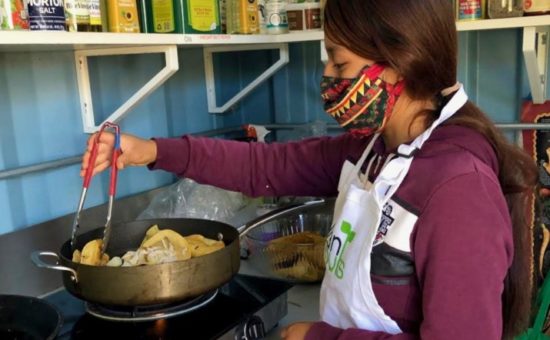
Sprouting Leaders member cooks in Urban Sprouts outdoor, off the grid, solar-powered kitchen.
The organization could also use volunteers to work on digital projects around data management, marketing, and graphic design. In regards to how readers can help, Marissa states: “If anyone lives in San Francisco and wants to help with garden maintenance, we do need help with basic garden care! It is not the most exciting work, but it feels good to be outside and getting your hands dirty.”
From Urban Sprouts:
“We build supportive learning communities in English, Spanish, and Cantonese, for people of all ages, genders, and races. We work with communities who have been systematically denied access to resources to remove barriers and create pathways to health and economic equity through garden-based education and experiences”
San Francisco, CA. The San Francisco Foundation COVID-19 Emergency Response Fund has offered a total of $627,000 in grants since it was launched in March.
The Emergency Response Fund makes grants of $5,000-$25,000 to nonprofit organizations that are serving: low-wage workers most affected by the crisis; residents who are homeless or in danger of losing their homes; people who may not be able to get food during this time; and communities who have been targeted because of their race as a result of hysteria around the pandemic.
The fund was launched on March 17th to provide quick funding to nonprofit organizations in San Francisco, Alameda, Contra Costa, Marin, and San Mateo counties.
An essential component of the fund is to get resources to the community quickly.
“Two areas that are particularly challenging right now are access to food and the need to protect unhoused people,” said Fred Blackwell, CEO of the San Francisco Foundation. “We are doing what we can to help fill the gaps and to move as quickly as humanly possible to get support out into the community.”
“We know that so much more help is needed,” said Elena Chávez Quezada, Vice President for Programs. “At the current rate of support, we are likely to run out of funding soon, so we are asking donors, corporations, and anyone who can help to do what they can.”
“We have been able to provide emergency funds to almost a hundred organizations in just a few weeks,” said Ruben Orduña, the foundation’s Chief of Philanthropy, who oversees the foundation’s fundraising activities. “We are especially grateful to our donors, who are providing essential resources at a time of incredible need. This includes corporations, foundations, fund holders at the foundation, and individuals who are eager to support members of the community who are most in need. Their continued support is so valuable and so welcome.”
To donate to the fund or apply for emergency funding, visit www.sff.org.
As Bay Area nonprofits rise to the challenge of meeting new and dramatically increased needs, we know that many are also struggling to keep their doors open and services running during this tumultuous time. San Francisco Foundation is working to support our grantees through this unprecedented time and to provide services and resources that all Bay Area nonprofits can use.
On this page, you’ll find important information on:
Nonprofits and community organizations throughout the Bay Area are moving quickly to protect their staff, stabilize their organizations, and deepen support for our most vulnerable communities. San Francisco Foundation is working with trusted providers to help Bay Area nonprofits adapt and strengthen their financial management, operations, and program strategies along with holistic wellness offerings for nonprofit staff.
Finance Practices and Tools in the Wake of COVID-19
The delivery of nonprofit programs in our community has and will continue to shift as organizations adapt to the current reality. These programmatic shifts coupled with uncertainty in revenue require nonprofits to make difficult decisions in a changing environment. SFF is partnering with Financial Management Associates (FMA) and Tipping Point Community to offer webinars and online tools for nonprofit organizations.
Prácticas y herramientas financieras a raíz del COVID-19
Los programas y servicios ofrecidos por las organizaciones comunitarias han cambiado y seguirán cambiando a medida que las organizaciones se adapten a la realidad actual. Estos cambios programáticos junto con la incertidumbre de los ingresos requieren que las organizaciones tomen decisiones difíciles en un ambiente cambiante. SFF se está asociando con Financial Management Associates (FMA) para ofrecer una serie de seminarios web de 3 partes para organizaciones comunitarias pequeñas y medianas del Área de la Bahía. Esta serie ayudará a los líderes de las organizaciones comunitarias a entender su situación financiera actual, a planificar posibles escenarios, y proyectar las necesidades económicas. Aprender más
Support for Virtual Fundraising and Remote Work
SFF supports Catchafire, an online tool that connects nonprofits with professionals who want to donate their skills, pro bono. Catchafire is currently offering free weekly webinars for all nonprofit and community organizations on building team culture while working virtually, fundraising in the time of COVID-19, and developing virtual fundraising events. Plus, Bay Area nonprofits can share ideas and access Catchafire experts on their shared Slack channel.
NONPROFIT BENEFIT TICKET GIVEAWAYS!
Sign up for our free weekly highlights for the chance to win two tickets terrific nonprofit events! If you “like” us on facebook, or sign up for our weekly news highlights, you’ll be entered to win! Sign up today!
Look for another ticket giveaway soon! Are you a nonprofit looking to bolster your publicity with facebook and tweets? Email us and we’ll run a contest with tickets to your event! [email protected]
Categories
Archives
Affiliates
Deprecated: Using null as an array offset is deprecated, use an empty string instead in /home2/societz9/public_html/sfsocietypage/wp-content/themes/Divi/includes/builder/class-et-builder-global-feature-base.php on line 188